
Dot Painting Mandala Art: The Ancient Technique Behind Every Blissfull Dots Creation
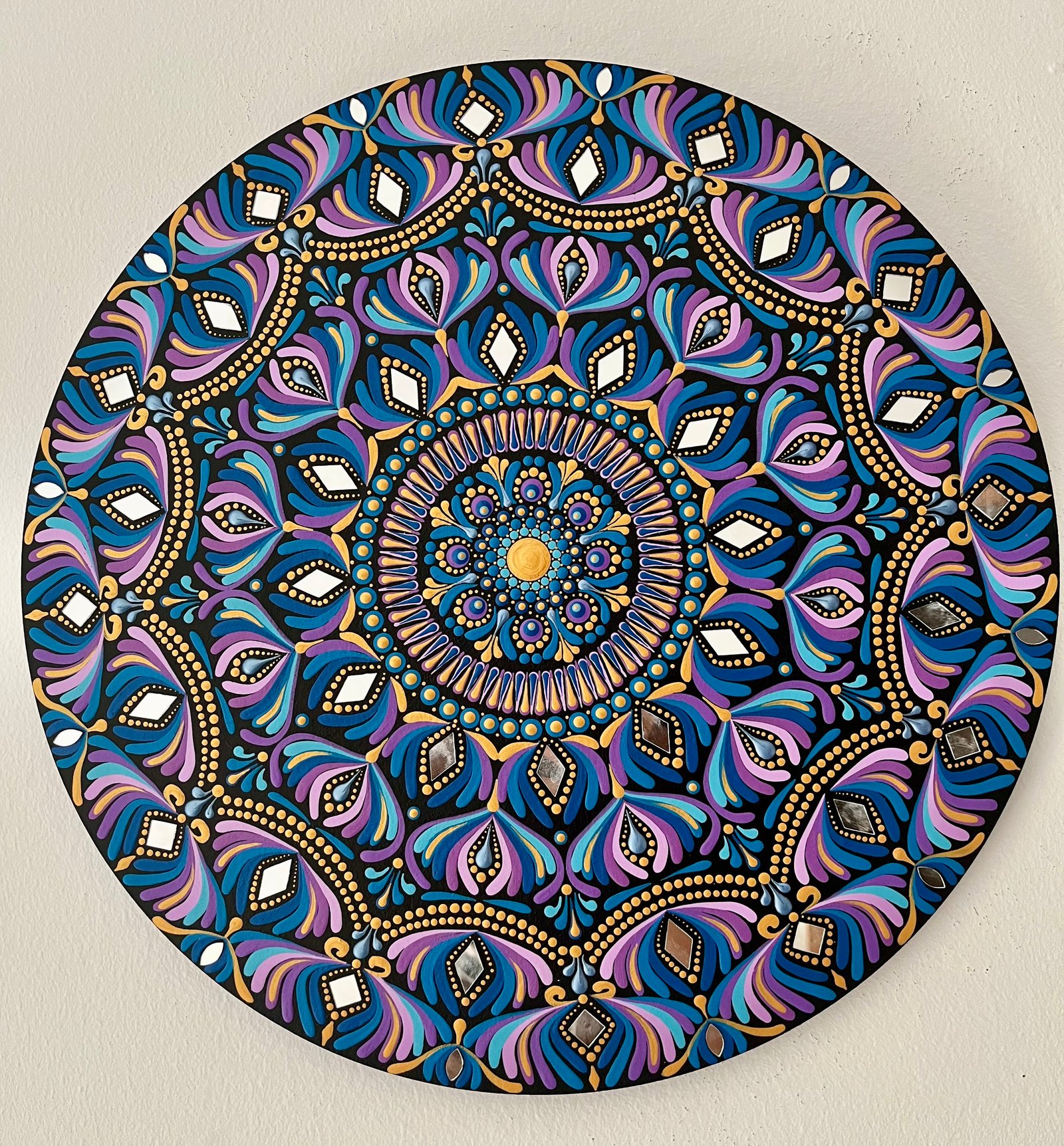
Look closely at a Blissfull Dots mandala and you’ll begin to see it — the thousands of individual dots, each one placed with intention, building outward from the centre into a composition of astonishing complexity. Step back, and those dots become feathers, petals, starbursts, geometric patterns that seem to breathe.
This is dot painting. And it’s one of the most meditative art forms humans have ever practised.
A Brief History of Dot Painting
Dots as a primary visual language appear independently across cultures and millennia. Australian Aboriginal dot painting, developed over 50,000 years, uses dots as a visual coding system to map sacred stories and land relationships. The Indigenous practice of creating ceremonial sand mandalas in Tibetan Buddhism uses granular material placed dot-by-dot to create impermanent, sacred geometric forms.
In Western art history, the Pointillists — Seurat, Signac — demonstrated scientifically that the eye and brain merge adjacent dots of colour into smooth tones and shapes. The technique exploits the way human perception works: individual small elements combining into a cohesive whole that transcends its parts.
When applied to mandala form — itself a radially symmetrical geometry of profound ancient significance — dot painting becomes something extraordinary. Each dot placed within a mandala structure participates in a design language thousands of years in the making.
The Meditative Discipline of Dot Painting
There is a reason dot-painted mandalas carry a particular energy that printed reproductions simply don’t. It’s because each dot is an act of presence.
Creating a detailed mandala in dot painting requires the artist to enter a state of focused attention. The mind cannot wander and place dots accurately at the same time. There’s no room for rumination, anxiety, or distraction — the work demands complete presence.
Many artists who work with dot mandalas describe entering what psychologists call a “flow state” — a condition of absorbed, effortless action in which time passes differently and a sense of deep satisfaction emerges. The practice of creating the mandala becomes a meditation in itself.
This energetic history accumulates in the finished piece. When you hang a dot-painted mandala in your home, you’re receiving an object that was created in a state of presence and intentionality. Many people report that this quality is perceptible — that there’s a calming quality to handcrafted mandalas that printed reproductions don’t possess.
The Process: How a Blissfull Dots Mandala Is Made
1. Preparation
Each piece begins with a quality MDF board, cut and sanded to create a smooth, stable surface. The base coat is applied and allowed to cure completely before any design work begins.
2. The Geometric Foundation
Using pencil, compass, and ruler, the foundational geometry of the mandala is laid out. This is a precision task — the radial symmetry of a mandala is unforgiving of errors. The centre point, ring divisions, petal positions, and geometric subdivisions must all be accurate before the first drop of paint is applied.
3. The First Layers
Flat areas of colour are applied first, establishing the overall palette. These base colours will show between and beneath the dot work, creating the background structure of the design.
4. Dot Application — The Core Work
Using tools of different sizes (specially designed mandala dotting tools, styluses, and the ends of various implements), dots are applied from the outer edges inward, or from the centre outward, depending on the design logic.
Each size of tool creates a different dot diameter. Building compositions that use multiple sizes creates depth and visual rhythm — the same way music uses notes of different lengths and pitches to create melody.
The raised dot technique — using a thicker acrylic medium — builds dots that stand above the surface, creating genuine three-dimensional texture. These catch light differently throughout the day, making the mandala a dynamic rather than static object.
5. Finishing
Once complete, the mandala is sealed with a protective matte or gloss varnish. This protects the surface from dust, moisture, and UV light. The varnish also deepens and enriches the colours, giving the finished piece its characteristic luminosity.
Why Dot Paintings Age Beautifully
A properly sealed, acrylic-painted mandala on MDF is remarkably durable. Unlike canvas prints that can yellow, or printed reproductions that fade, handcrafted acrylic paintings maintain their colour integrity for decades. The 3D dot embellishments remain stable and don’t flatten over time.
Many collectors report that they discover new details in their mandalas for years after purchase — a particular arrangement of dots noticed only at a certain time of day, or a pattern within a pattern only visible at close range.
This is the nature of works created with thousands of individual decisions. They reward sustained looking in a way that digitally produced imagery simply cannot.
Start Your Collection
Every piece in the Blissfull Dots collection is created using this process — patient, precise, meditative dot painting on quality MDF. Browse the full collection to find a piece that speaks to you, or commission a custom mandala that incorporates the colours, symbols, and scale that are perfect for your space.
The dots are waiting to be placed — with your space and intention in mind.
Love what you're reading?
Explore handcrafted mandala art made with intention — or commission something uniquely yours.